Website Notice: We are making improvements to our website layout to provide a better browsing experience. Some content may be updated during this process.
What Happens When Practice Information Lives in Too Many Places
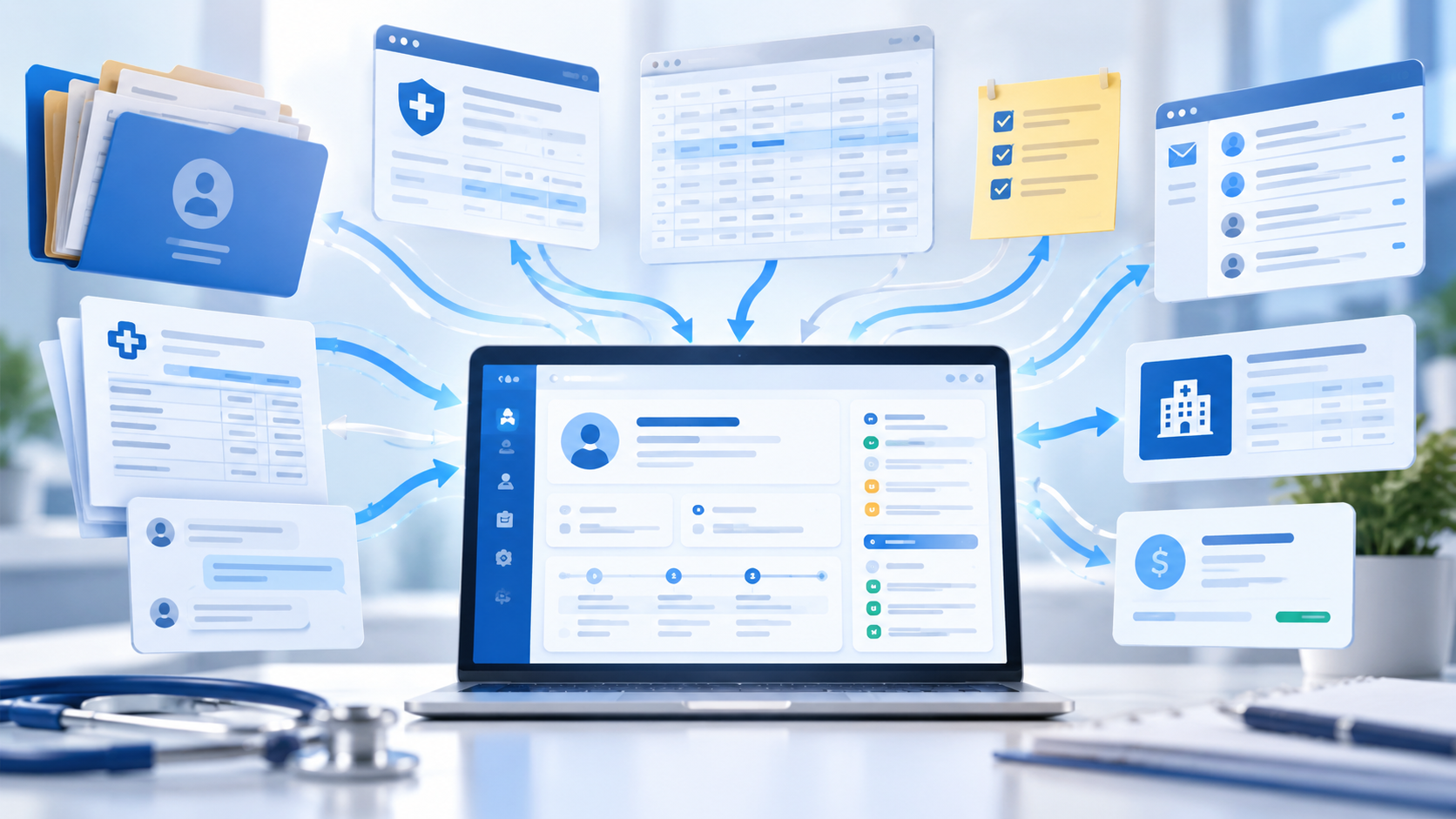
A patient account can involve a surprising amount of information.
Insurance details.
Authorization notes.
Claim history.
Payer responses.
Patient communication.
Payment information.
Follow-up activity.
Documentation requests.
Staff notes.
The challenge is not always whether that information exists.
Sometimes the real problem is where it exists.
When staff have to move between multiple systems, portals, spreadsheets, inboxes, notes, and worklists just to understand one account, the work becomes harder than it needs to be.
And when information is difficult to find, revenue work can slow down with it.
Visibility
Make account information easier to find across systems, portals, notes, and worklists.
Search Time
See how repeated searching for account details can quietly consume staff time.
AR Impact
Understand how fragmented information can delay follow-up and allow accounts to keep aging.
Account Context
Give staff and leaders the history and context behind why an account is still open.
Actionable Information
Help teams spend less time rebuilding the account story and more time taking the next action.
1. More Information Does Not Always Mean Better Visibility
Healthcare practices collect a large amount of information every day.
But having information and being able to use it quickly are not the same thing.
One employee may document a payer call in an account note.
Another may track follow-up in a spreadsheet.
A request may arrive through email.
A payer status may only be visible inside a portal.
Another staff member may have already researched the account but documented the details somewhere else.
The practice technically has the information.
The next employee simply may not know where to find it.
That creates a visibility problem.
Instead of moving directly to the next action, staff first have to reconstruct what already happened.
2. Searching for Information Can Quietly Consume Staff Time
A few extra minutes may not seem important.
But consider how often staff perform the same type of search.
Opening another system.
Checking the payer portal.
Looking through previous notes.
Searching email.
Asking another employee.
Comparing information across screens.
Trying to determine whether a task was already completed.
When that happens repeatedly throughout the day, information searching becomes part of the workload.
The problem is that this work does not necessarily move the account forward.
Staff may spend ten minutes understanding the account before they can spend two minutes taking the actual next step.
Across hundreds of accounts, that difference becomes significant.
What looks like an employee productivity problem may actually be an information-access problem.
3. Fragmented Information Can Affect AR and Patient Accountsn They Seem
When account information is scattered, the financial impact may appear later.
A payer request can be overlooked.
A follow-up can be repeated unnecessarily.
A claim may remain pending because staff do not realize documentation is needed.
A patient balance may be reviewed without seeing recent insurance activity.
A payment may be researched again even though another employee already identified the issue.
The account continues aging while staff search for context.
This can make AR management more difficult because the balance alone does not explain what is happening.
A manager may see an old account and ask why it has not been resolved.
The answer may not be that nobody worked it.
Several people may have worked it.
The problem may be that each person had to rediscover part of the story before continuing.
That is operational friction hidden inside everyday account work.
4. Practice Leaders Need More Than Separate Reports
Reports are useful.
They can show aging, collections, balances, denials, write-offs, or other financial outcomes.
But practice leaders also need context.
Why is the account still open?
What happened during the last review?
Is someone waiting for information?
Has another employee already taken action?
What is supposed to happen next?
Are the same problems appearing repeatedly?
These questions become harder to answer when relevant information is spread across different places.
This is where better account visibility becomes valuable.
Zybex helps healthcare organizations manage the information and activity surrounding AR and patient accounts so staff can better understand account history, prior actions, and what may still require attention.
The goal is not simply to create more data.
It is to make the information already being generated easier to understand and use.
5. Make Information Easier to Act On
Practices may not be able to eliminate every system, portal, or source of information.
Healthcare operations naturally involve multiple platforms and outside organizations.
But teams can still examine how easily information moves through the practice.
Can another employee understand an account without starting the research again?
Can staff see what has already been done?
Is important information reaching the people who need it?
Can managers identify accounts that are waiting, stalled, or repeatedly researched?
Are employees spending more time searching for information than acting on it?
Those questions can reveal whether the practice has an information problem disguised as a workflow problem.
Because better practice management is not only about collecting more information.
It is about making sure the right information is available when someone needs to make the next decision.
And when that happens, staff can spend less time rebuilding the account story and more time moving the account forward.
See where information and workflow friction may be affecting your practice:
Healthcare Operations Friction Assessment
https://www.zybex.com/healthcare-operations-friction-assessment/
Healthcare Operations Friction Toolkit
https://www.zybex.com/healthcare-operations-friction-toolkit/
Learn more about Zybex healthcare revenue and practice management solutions:
https://www.zybex.com/cybermed-ai/
In This Article
- 01 Visibility
- 02 Search Time
- 03 AR Impact
- 04 Account Context
- 05 Actionable Information
Related Post



Featured Resource
Healthcare Operations Friction Assessment
Healthcare Operations Friction Toolkit
Enter your email below to receive the toolkit.
Healthcare Operations Friction Toolkit
Enter your name and email below to access the toolkit
Thank you.
Your Healthcare Operations Friction Toolkit is ready.
Find the Friction Behind the Account
See where workflow friction may be making AR work harder than necessary.
Cookie Consent
We use cookies to improve your experience on our site. By using our site, you consent to cookies.
Cookie Preferences
Manage your cookie preferences below:
Essential cookies enable basic functions and are necessary for the proper function of the website.
Name
Description
Duration
Cookie Preferences
This cookie is used to store the user's cookie consent preferences.
30 days
These cookies are needed for adding comments on this website.
Name
Description
Duration
comment_author
Used to track the user across multiple sessions.
Session
comment_author_email
Used to track the user across multiple sessions.
Session
comment_author_url
Used to track the user across multiple sessions.
Session
Statistics cookies collect information anonymously. This information helps us understand how visitors use our website.
Google Analytics is a powerful tool that tracks and analyzes website traffic for informed marketing decisions.
Service URL: policies.google.com (opens in a new window)
Name
Description
Duration
_gac_
Contains information related to marketing campaigns of the user. These are shared with Google AdWords / Google Ads when the Google Ads and Google Analytics accounts are linked together.
90 days
__utma
ID used to identify users and sessions
2 years after last activity
__utmt
Used to monitor number of Google Analytics server requests
10 minutes
__utmb
Used to distinguish new sessions and visits. This cookie is set when the GA.js javascript library is loaded and there is no existing __utmb cookie. The cookie is updated every time data is sent to the Google Analytics server.
30 minutes after last activity
__utmc
Used only with old Urchin versions of Google Analytics and not with GA.js. Was used to distinguish between new sessions and visits at the end of a session.
End of session (browser)
__utmz
Contains information about the traffic source or campaign that directed user to the website. The cookie is set when the GA.js javascript is loaded and updated when data is sent to the Google Anaytics server
6 months after last activity
__utmv
Contains custom information set by the web developer via the _setCustomVar method in Google Analytics. This cookie is updated every time new data is sent to the Google Analytics server.
2 years after last activity
__utmx
Used to determine whether a user is included in an A / B or Multivariate test.
18 months
_ga
ID used to identify users
2 years
_gali
Used by Google Analytics to determine which links on a page are being clicked
30 seconds
_ga_
ID used to identify users
2 years
_gid
ID used to identify users for 24 hours after last activity
24 hours
_gat
Used to monitor number of Google Analytics server requests when using Google Tag Manager
1 minute
You can find more information in our Cookie Policy and .