
Website Notice: We are making improvements to our website layout to provide a better browsing experience. Some content may be updated during this process.
The Difference Between a Denial, Rejection, and Underpayment—and Why It Matters
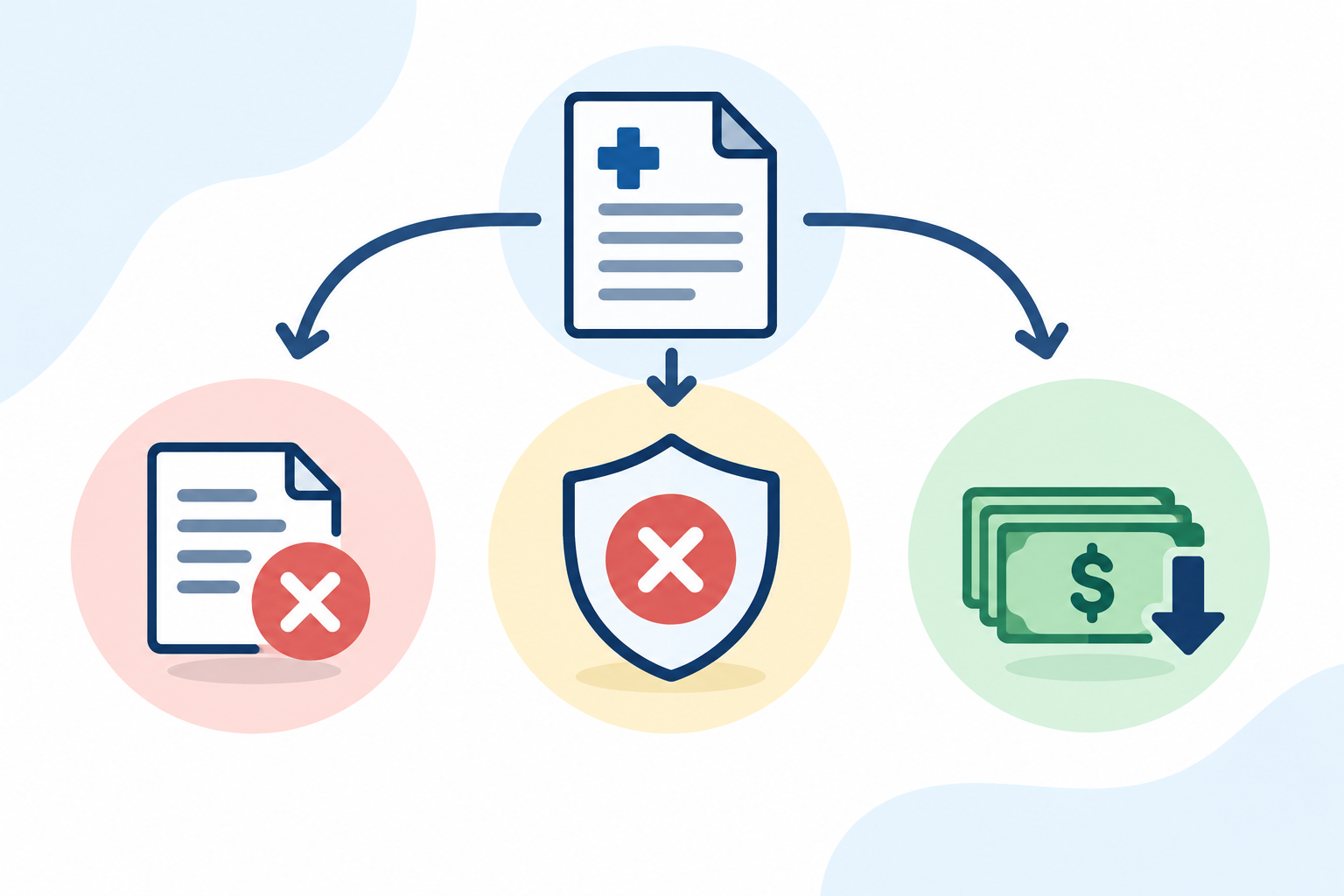
A claim has a problem.
But what kind of problem?
Was it rejected before it could be properly processed?
Was it processed and then denied?
Or did the payer issue payment, but for less than the practice expected?
To a busy medical billing team, all three situations can appear in AR as money that has not been fully collected.
But they are not the same problem.
And treating them the same way can lead to unnecessary resubmissions, incorrect follow-up, missed reimbursement, and more time spent researching accounts that require completely different actions.
The first step toward working an account effectively is knowing what actually happened to the claim.
Rejection
Claim was not accepted for processing.
Denial
Payer processed the claim but did not approve payment.
Underpayment
Payment was issued, but less than expected.
Right Action
Identify the issue before taking the next step.
Account Context
See the history and details behind the balance.
Three Problems That Require Different Responses
A rejection, denial, and underpayment can all leave money outstanding, but they happen at different points in the claim process.
A rejection generally means the claim or transaction was not accepted for normal processing because something prevented it from meeting submission requirements. CMS guidance, for example, identifies incomplete or incorrect billing information among reasons a claim transaction may be rejected and notes that rejected Medicare claims are corrected and resubmitted as new claims.
A denial means the claim has reached a payer decision in which payment or coverage is not allowed in whole or in part. Depending on the reason, the appropriate response may involve correction, additional documentation, reconsideration, appeal, or another payer-specific action.
An underpayment is different again.
The payer has issued payment, but the amount may not match the reimbursement the practice expected. Understanding the difference requires reviewing the remittance, allowed amount, adjustments, patient responsibility, and other payment information. Standard adjustment and remark codes are used on remittance advice to explain claim-level or service-line payment adjustments.
The balance may look similar on the AR report.
The solution may be completely different.
A Rejection Often Starts with the Claim Itself
When a claim is rejected, the first question should be:
What prevented this claim from being accepted correctly?
The issue may involve information such as:
- Patient or subscriber information
- Insurance details
- Provider information
- Required claim fields
- Invalid or incomplete billing data
- Submission to the wrong payer or destination
- Other formatting or submission requirements
The important point is that staff should identify and correct the reason for the rejection before simply sending the same information again.
Repeatedly submitting a claim without correcting the underlying problem does not create progress.
It creates another cycle of work.
A good rejection review should make it easy for staff to see what failed, what needs correction, and whether the corrected claim has actually been accepted afterward.
A Denial Requires Understanding the Payer's Decision
A denied claim has a different story.
The payer has made a decision about the claim or service, so simply treating it as a submission problem may lead staff in the wrong direction.
The denial may involve issues such as:
- Eligibility or coverage
- Authorization
- Medical necessity
- Documentation
- Coding
- Timely filing
- Duplicate billing
- Coordination of benefits
- Payer-specific requirements
Different denial reasons require different responses.
One claim may need supporting documentation.
Another may require a corrected claim.
Another may need an appeal.
And another may have been processed correctly and require no additional payer action.
That is why the denial reason matters more than the word “denied.”
Before taking action, staff need to understand what the payer actually decided and what options remain.
An Underpayment Can Be Harder to Notice
Underpayments present another challenge because the account shows something positive:
Money was received.
That can make the claim look less urgent than a rejection or denial.
But payment does not automatically mean the reimbursement was correct.
Staff may need to compare:
- The billed amount
- The expected or contracted allowed amount
- The payer payment
- Adjustments
- Patient responsibility
- Secondary responsibility
- The remaining account balance
The payer’s remittance information helps explain how a payment was calculated and why adjustments were made.
If the amount does not align with what the practice reasonably expected, the account may still require investigation.
This is especially important when the same payment difference begins appearing repeatedly across similar claims.
A small discrepancy on one claim may be easy to overlook.
Repeated across many claims, it can become a much larger revenue issue.
Misclassifying the Problem Can Create More AR Work
The wrong classification often leads to the wrong action.
Imagine three accounts with outstanding balances.
On the first, staff keep calling the payer even though the claim was rejected and simply needs corrected information.
On the second, staff repeatedly resubmit a denied claim even though the payer is waiting for documentation.
On the third, staff accept the payment and move the remaining amount forward without noticing that reimbursement may have been lower than expected.
All three accounts are being worked.
But activity is not the same as effective AR management.
The more useful question is:
Getting that answer early can prevent unnecessary calls, duplicate submissions, incorrect patient billing, and repeated account research.
When an account shows an unexpected balance, staff can begin with three questions.
If not, determine why it was rejected and what needs to be corrected before resubmission.
Review the payer response, denial or adjustment information, and any action required.
Compare the payment, allowed amount, adjustments, patient responsibility, and expected reimbursement.
From there, staff can determine whether the account needs:
- Correction and resubmission
- Documentation
- Payer follow-up
- Appeal or reconsideration
- Contract or payment review
- Secondary billing
- Patient billing
- Adjustment
- Another account-specific action
The purpose of this review is not to add another complicated step.
It is to prevent staff from spending time on the wrong one.
Better Account Context Helps Teams Choose the Right Action
Rejections, denials, and underpayments demonstrate why an AR balance alone is not enough.
A balance tells staff that money remains.
It does not necessarily explain why.
Teams also need access to the claim history, payer response, previous actions, payment information, supporting documentation, and other context surrounding the account.
When that information is scattered across several systems or difficult to reconstruct, even identifying the type of problem can consume unnecessary staff time.
Zybex helps healthcare organizations manage the information and activity surrounding AR accounts so teams can better understand what happened, what has already been done, and what may still require attention.
The goal is not simply to put more information in front of staff.
It is to help make the information surrounding an account useful when someone needs to decide what to do next.
Find the Friction Behind the Account
A rejection, denial, or underpayment may begin as a claim-level issue.
But the way the team handles it can reveal something larger about the operation.
Can staff quickly tell whether the claim was rejected or denied?
Can they easily find the payer’s reason?
Can they see what action another employee already took?
Can they recognize when a payment may be lower than expected?
Can they identify similar problems happening across other accounts?
If answering those questions requires extensive searching, repeated payer calls, or rebuilding account history every time someone touches the claim, the issue may involve more than the claim itself.
It may be exposing operational friction.
The Healthcare Operations Friction Assessment helps medical practices identify where information, processes, handoffs, and everyday account work may be creating unnecessary difficulty.
Take the Healthcare Operations Friction Assessment:
The Healthcare Operations Friction Toolkit can also help teams review practical areas of their workflow and identify opportunities to make account work more structured and manageable.
Because a denial, rejection, and underpayment may all appear as money still sitting in AR.
But knowing which problem you are actually dealing with is what helps determine the right response.
In This Article
- 01 Rejection
- 02 Denial
- 03 Underpayment
- 04 Correct Classification
- 05 Account Context
Related Post




Featured Resource
Healthcare Operations Friction Assessment

Healthcare Operations Friction Toolkit
Enter your email below to receive the toolkit.
Healthcare Operations Friction Toolkit
Enter your name and email below to access the toolkit
Thank you.
Your Healthcare Operations Friction Toolkit is ready.
Find the Friction Behind the Account
See where workflow friction may be making AR work harder than necessary.
Cookie Consent
We use cookies to improve your experience on our site. By using our site, you consent to cookies.
Cookie Preferences
Manage your cookie preferences below:
Essential cookies enable basic functions and are necessary for the proper function of the website.
Name
Description
Duration
Cookie Preferences
This cookie is used to store the user's cookie consent preferences.
30 days
These cookies are needed for adding comments on this website.
Name
Description
Duration
comment_author
Used to track the user across multiple sessions.
Session
comment_author_email
Used to track the user across multiple sessions.
Session
comment_author_url
Used to track the user across multiple sessions.
Session
Statistics cookies collect information anonymously. This information helps us understand how visitors use our website.
Google Analytics is a powerful tool that tracks and analyzes website traffic for informed marketing decisions.
Service URL: policies.google.com (opens in a new window)
Name
Description
Duration
_gac_
Contains information related to marketing campaigns of the user. These are shared with Google AdWords / Google Ads when the Google Ads and Google Analytics accounts are linked together.
90 days
__utma
ID used to identify users and sessions
2 years after last activity
__utmt
Used to monitor number of Google Analytics server requests
10 minutes
__utmb
Used to distinguish new sessions and visits. This cookie is set when the GA.js javascript library is loaded and there is no existing __utmb cookie. The cookie is updated every time data is sent to the Google Analytics server.
30 minutes after last activity
__utmc
Used only with old Urchin versions of Google Analytics and not with GA.js. Was used to distinguish between new sessions and visits at the end of a session.
End of session (browser)
__utmz
Contains information about the traffic source or campaign that directed user to the website. The cookie is set when the GA.js javascript is loaded and updated when data is sent to the Google Anaytics server
6 months after last activity
__utmv
Contains custom information set by the web developer via the _setCustomVar method in Google Analytics. This cookie is updated every time new data is sent to the Google Analytics server.
2 years after last activity
__utmx
Used to determine whether a user is included in an A / B or Multivariate test.
18 months
_ga
ID used to identify users
2 years
_gali
Used by Google Analytics to determine which links on a page are being clicked
30 seconds
_ga_
ID used to identify users
2 years
_gid
ID used to identify users for 24 hours after last activity
24 hours
_gat
Used to monitor number of Google Analytics server requests when using Google Tag Manager
1 minute
You can find more information in our Cookie Policy and .