
Website Notice: We are making improvements to our website layout to provide a better browsing experience. Some content may be updated during this process.
The AR Risk Hidden in Payer Recoupments

The claim was paid.
The payment was posted.
The account looked resolved.
Then, weeks or even months later, the money is taken back.
Payer recoupments can create a unique AR challenge because they reopen accounts that may no longer be receiving the same attention as active denials or unpaid claims.
A payer may determine that a previous payment was incorrect or that an overpayment occurred. Depending on the payer and situation, recovery may appear through a reversal, adjustment, offset against future payments, or another repayment process. Medicare, for example, uses recoupment as one method of recovering certain overpayments.
For the medical practice, the important question is not simply:
“Why did the payer take money back?”
It is:
“What changed on the original claim, and what does that mean for the account now?”
A Previously Paid Claim Can Return to AR
One of the reasons recoupments are easy to miss is that the original claim may have already disappeared from the team’s day-to-day attention.
The account may have been paid and closed.
The patient’s balance may have been settled.
A secondary payer may have processed its portion.
Reports may have previously shown the account as complete.
Then the payer changes the financial outcome.
The practice may suddenly need to determine:
- Which original claim is connected to the recoupment
- Why the payer believes money should be recovered
- Whether the entire payment or only part of it was affected
- Whether a previous adjustment changed
- Whether the patient or secondary payer balance is now different
- Whether the payer’s decision should be reviewed or challenged
- Whether similar claims may also be affected
This is why a recoupment should not be viewed as only a negative payment entry.
It changes the story of an account that may have already been considered finished.
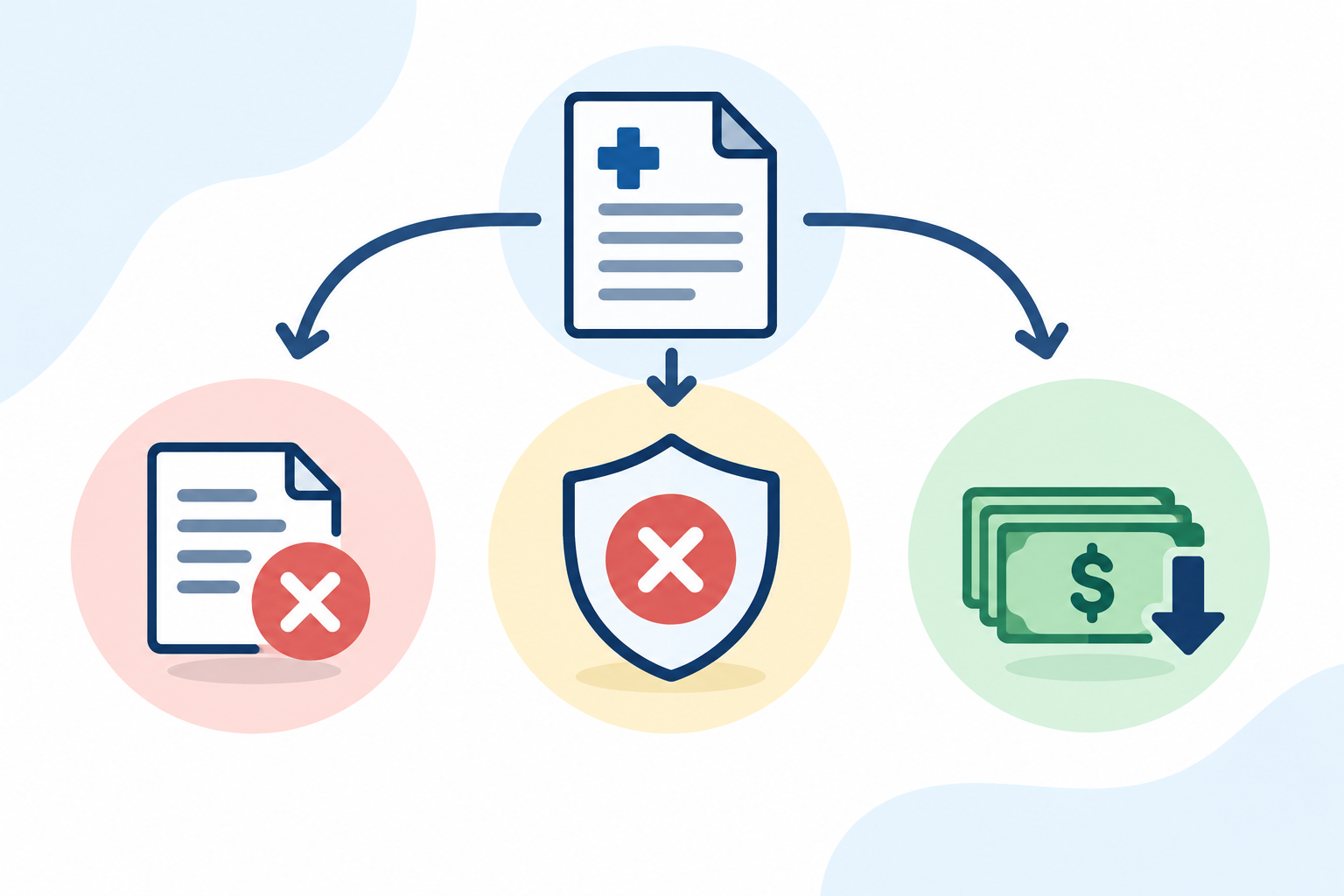
Reopened Paid Claim
Paid claim returns to AR.
Original Claim Trace
ayment is reversed or reduced.
Payment Adjustment
Payment is reversed or reduced.
Account Impact
Balance and responsibility may change.
Recurring Pattern
Repeated recoupments may reveal a trend.
Start by Tracing the Recoupment Back to the Original Claim
When money is recovered, staff need to connect that transaction to the claim that created it.
The remittance information can be especially important.
For Medicare, the remittance advice reports claim adjudication and payment information, including the reasons and amounts associated with adjustments.
Staff should review information such as:
- Original claim and date of service
- Original payment
- Current payer adjustment
- Amount being recovered
- Adjustment or remark information
- Any revised patient responsibility
- Previous claim corrections or reprocessing
- Payer correspondence related to the recovery
Looking only at the current payment batch may not provide enough context.
The team needs to understand what happened before the recoupment and what the payer has changed now.
Understand Why the Payment Changed
A payer taking money back does not automatically tell staff what action should follow.
The underlying reason matters.
A previous payment may have been reconsidered because of claim processing, coverage, coding, documentation, coordination of benefits, duplicate payment, or another payer-specific issue.
The practice should therefore avoid responding to every recoupment with the same workflow.
Instead, ask:
What determination changed?
What documentation supports the payer’s action?
Does the practice agree with the revised outcome?
Is another claim, payer, or patient balance affected?
Is there an available review or appeal process?
For Medicare claims, providers may have appeal rights when they disagree with certain claim determinations, and CMS outlines multiple levels of appeal. Other payers may have different procedures and deadlines, so staff should follow the notice and requirements applicable to the specific payer.
Understanding the reason first helps prevent the team from spending time on an action that does not address the actual issue.
Do Not Forget the Rest of the Account
A recoupment does not always affect only the payer payment.
It can change other parts of the account as well.
For example, staff may need to determine whether the recoupment changes:
- Patient responsibility
- Secondary insurance responsibility
- Contractual adjustments
- The outstanding AR balance
- A previous patient payment
- A credit balance
- A refund that was already issued
- Another claim connected to the same service
This becomes especially important when activity occurred after the original payer payment.
Imagine that the primary payer originally paid the claim, the secondary payer processed the remaining balance, and the patient later paid their portion.
If the primary payer subsequently reverses or recoups part of its payment, the practice cannot understand the new balance by looking at the recoupment alone.
The entire account may need to be reviewed again.
Watch the Impact on Current Payments
Recoupment can also be confusing when the payer does not simply request a separate repayment.
In some payer processes, money owed may be recovered by reducing or offsetting later payments. Medicare’s financial management guidance, for example, describes recoupment of overpayments from amounts otherwise payable to the provider or supplier.
That can make reconciliation more difficult.
A current claim may have been processed correctly, while the payment received is lower because money was withheld for an older account.
Without enough context, staff may begin researching the current claim when the real issue belongs to a completely different one.
This is why the team should be able to distinguish between:
What was paid on today’s claims
and
What was withheld because of a previous obligation.
If those two activities are not connected clearly, recoupments can create misleading balances and unnecessary AR investigation.
One Recoupment May Be an Account Problem. Several May Be a Pattern.
A single recoupment deserves review.
Several similar recoupments deserve another question:
Why is this happening repeatedly?
Practices should look for similarities such as:
- The same payer
- The same procedure or service
- The same type of adjustment
- The same provider
- The same coverage situation
- Similar documentation issues
- Similar claim submission patterns
CMS itself uses processes such as recovery audits to identify improper Medicare payments, including overpayments and underpayments.
For the practice, repeated recoupments can also provide useful operational information.
If several previously paid claims are being reversed for the same reason, repeatedly fixing each account may not be enough.
The practice should also ask whether something earlier in the revenue cycle can be reviewed.
A Simple Payer Recoupment Review
When a recoupment appears, staff can begin with a short review:
Connect the recovery to the correct patient, claim, service, and original payment.
Review the remittance, adjustment information, payer correspondence, and account history.
Determine how the recovery affects the payer payment, adjustments, patient responsibility, secondary insurance, and remaining balance.
If not, review the payer’s applicable reconsideration, appeal, or dispute process.
Check secondary payments, patient payments, statements, refunds, adjustments, and other activity.
Look for a recurring pattern rather than treating every recoupment as an isolated event.
This review helps the team understand the entire financial impact before deciding what should happen next.
Better Account History Matters When the Past Changes
Recoupments demonstrate an important reality of healthcare AR:
An account that looked complete yesterday may not remain complete tomorrow.
That makes account history especially valuable.
Staff may need to reconstruct what the payer originally paid, what adjustments were made, what other payers did afterward, what the patient was billed, and why the payer is now changing the outcome.
When that information is scattered across multiple locations, researching an old account can become surprisingly time-consuming.
Zybex helps healthcare organizations manage the information and activity surrounding AR accounts so teams can better understand account history, previous actions, payer activity, and what may still require attention.
That visibility becomes particularly valuable when an older claim suddenly returns to AR.
The goal is not simply to see that money was taken back.
It is to understand why the account changed and what the practice should review because of that change.
Find the Friction Behind the Account
A payer recoupment may begin with one old claim.
But resolving it can touch multiple parts of the practice’s AR process.
Can staff quickly identify which payment was recovered?
Can they connect it to the original claim?
Can they see what happened after the original payment?
Can they determine whether the patient’s balance changed?
Can they recognize when the same recoupment reason is appearing across other accounts?
If answering those questions requires rebuilding months of account activity, searching multiple systems, or asking several people what happened, the recoupment may be exposing more than a payer issue.
It may be exposing operational friction.
The Healthcare Operations Friction Assessment helps medical practices examine where information, processes, handoffs, and everyday account work may be creating unnecessary difficulty.
The Healthcare Operations Friction Toolkit can also help teams review practical areas of their operations and identify where better structure may make complex AR situations easier to manage.
Because the biggest risk in a payer recoupment is not simply that money was taken back.
It is discovering too late that an account everyone thought was finished still required attention.
In This Article
- 01 Reopened Claim
- 02 Claim Trace
- 03 Payment Adjustment
- 04 Account Impact
- 05 Recurring Pattern
Related Post



Featured Resource
Healthcare Operations Friction Assessment

Healthcare Operations Friction Toolkit
Enter your email below to receive the toolkit.
Healthcare Operations Friction Toolkit
Enter your name and email below to access the toolkit
Thank you.
Your Healthcare Operations Friction Toolkit is ready.
Find the Friction Behind the Account
See where workflow friction may be making AR work harder than necessary.
Cookie Consent
We use cookies to improve your experience on our site. By using our site, you consent to cookies.
Cookie Preferences
Manage your cookie preferences below:
Essential cookies enable basic functions and are necessary for the proper function of the website.
Name
Description
Duration
Cookie Preferences
This cookie is used to store the user's cookie consent preferences.
30 days
These cookies are needed for adding comments on this website.
Name
Description
Duration
comment_author
Used to track the user across multiple sessions.
Session
comment_author_email
Used to track the user across multiple sessions.
Session
comment_author_url
Used to track the user across multiple sessions.
Session
Statistics cookies collect information anonymously. This information helps us understand how visitors use our website.
Google Analytics is a powerful tool that tracks and analyzes website traffic for informed marketing decisions.
Service URL: policies.google.com (opens in a new window)
Name
Description
Duration
_gac_
Contains information related to marketing campaigns of the user. These are shared with Google AdWords / Google Ads when the Google Ads and Google Analytics accounts are linked together.
90 days
__utma
ID used to identify users and sessions
2 years after last activity
__utmt
Used to monitor number of Google Analytics server requests
10 minutes
__utmb
Used to distinguish new sessions and visits. This cookie is set when the GA.js javascript library is loaded and there is no existing __utmb cookie. The cookie is updated every time data is sent to the Google Analytics server.
30 minutes after last activity
__utmc
Used only with old Urchin versions of Google Analytics and not with GA.js. Was used to distinguish between new sessions and visits at the end of a session.
End of session (browser)
__utmz
Contains information about the traffic source or campaign that directed user to the website. The cookie is set when the GA.js javascript is loaded and updated when data is sent to the Google Anaytics server
6 months after last activity
__utmv
Contains custom information set by the web developer via the _setCustomVar method in Google Analytics. This cookie is updated every time new data is sent to the Google Analytics server.
2 years after last activity
__utmx
Used to determine whether a user is included in an A / B or Multivariate test.
18 months
_ga
ID used to identify users
2 years
_gali
Used by Google Analytics to determine which links on a page are being clicked
30 seconds
_ga_
ID used to identify users
2 years
_gid
ID used to identify users for 24 hours after last activity
24 hours
_gat
Used to monitor number of Google Analytics server requests when using Google Tag Manager
1 minute
You can find more information in our Cookie Policy and .