
Website Notice: We are making improvements to our website layout to provide a better browsing experience. Some content may be updated during this process.
Why Patient Credit Balances Deserve More Attention Than Most Practices Give Them

Most AR conversations focus on money that has not been collected.
Unpaid claims.
Denials.
Underpayments.
Old patient balances.
But there is another type of balance that deserves just as much attention:
Money sitting on an account that may no longer belong to the practice.
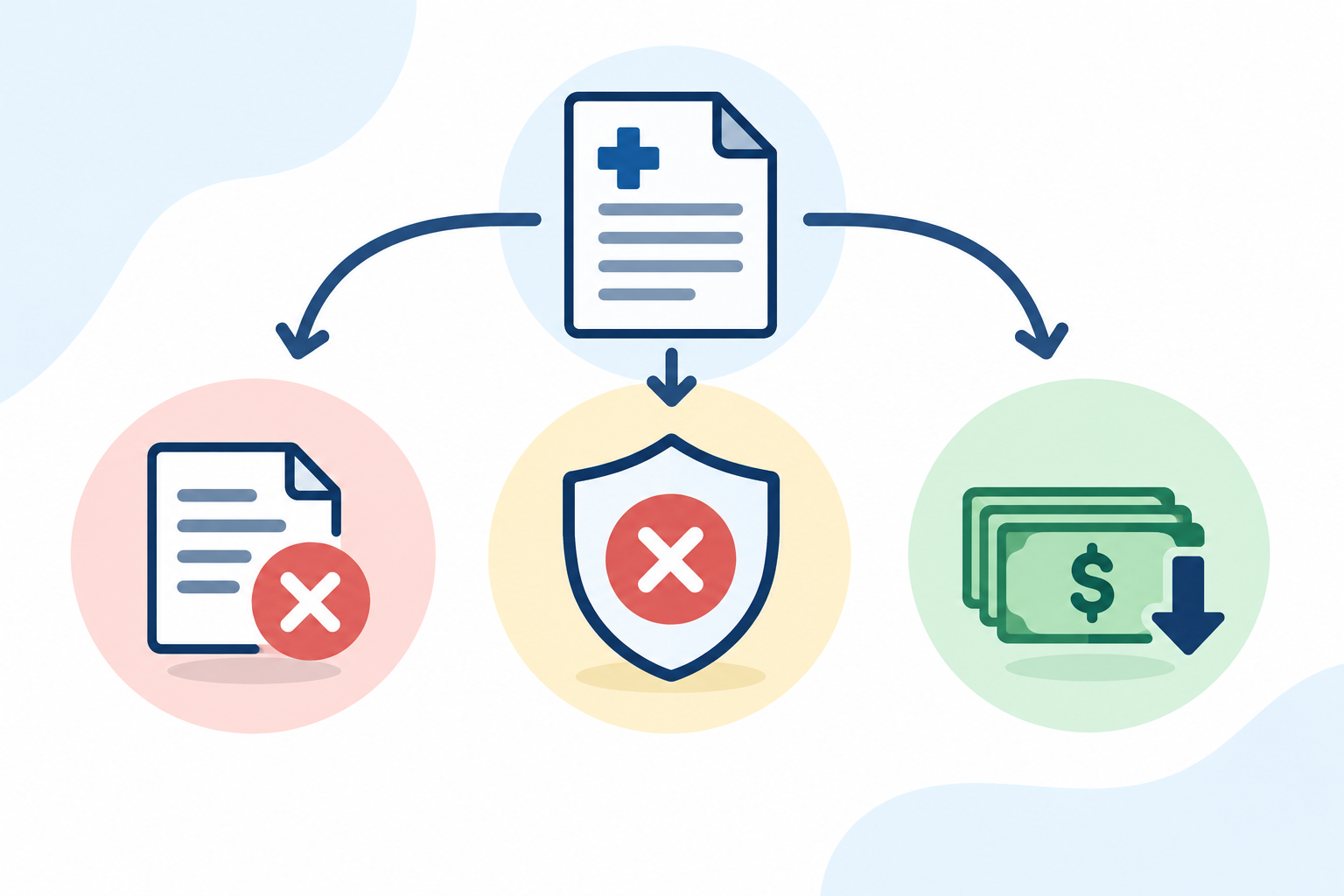
A patient credit balance can appear when payments, adjustments, insurance activity, or patient responsibility do not line up as expected.
Because the account shows a credit instead of money owed, it may not receive the same attention as traditional AR.
But a credit balance should not simply sit unnoticed.
The important question is:
“Why is this account showing a credit, and what should happen to that money?”
Until that question is answered, the account may not actually be finished.
Credit Balance
A credit may signal unresolved account activity.
Payment Source
Identify who made the extra payment.
Insurance Status
Confirm insurance processing is complete.
Refund Reconciliation
Verify the balance before issuing a refund.
Credit Patterns
Repeated credits may reveal workflow issues.
A Credit Balance Is a Signal, Not a Resolution
A credit balance can appear for several reasons.
For example:
- A patient may have paid more than their final responsibility
- Insurance may have paid after the patient already made a payment
- Primary and secondary insurance payments may overlap
- A claim may have been reprocessed
- A payment may have been posted twice
- A payment may have been applied incorrectly
- An adjustment may not match the final payer determination
- A refund may already have been processed but not reflected correctly
The important point is that the credit itself does not explain what happened.
Staff still need to trace the activity behind it.
Medicare provides a useful example of why healthcare organizations need to actively identify credit balances and overpayments. CMS defines a Medicare credit balance as an improper or excess payment made to a provider as a result of patient billing or claims processing.
The exact requirements and refund processes vary by payer and situation, but the operational lesson applies more broadly:
A credit should be investigated rather than assumed to be harmless.
Start With Who Actually Made the Extra Payment
Before deciding what to do with a credit balance, determine where the money came from.
Was it paid by the patient?
Primary insurance?
Secondary insurance?
Another payer?
Was there more than one payment for the same service?
That distinction matters because the correct next action depends on who is actually owed the money.
Imagine a patient pays their estimated responsibility at the time of service.
Later, insurance processes the claim and assigns a lower amount to the patient.
The patient’s payment may now exceed their final responsibility.
CMS explains that an EOB shows the patient’s responsibility after insurance processing, but it does not necessarily show amounts the patient has already paid directly to the provider.
That means staff may need to compare the payer’s final determination with the patient’s actual payment history before they can understand the credit.
Looking only at the current balance may not provide enough information.
Check Whether Insurance Activity Is Really Finished
A credit balance can become more complicated when insurance activity is still changing.
Before determining that money should be refunded, staff should check whether:
- Another payer still needs to process
- The claim was recently reprocessed
- A previous insurance payment was reversed
- A corrected remittance has been received
- Secondary insurance is still involved
- The payer has requested or initiated an adjustment
- Another related claim could affect the balance
This is especially important when a claim has changed after the original payment.
A patient account may temporarily show a credit during the middle of a larger insurance transaction.
If staff look only at the current balance without reviewing the full history, they may act before the financial outcome is actually settled.
A Refund Should Follow Reconciliation
When an account shows a patient credit, the instinct may be:
“Send the patient the money back.”
But first, the practice needs to confirm that the credit is real and that the amount is correct.
That means reconciling the account.
Staff should be able to answer:
What did the patient pay?
What did insurance ultimately determine the patient owed?
Were all insurance payments and adjustments posted correctly?
Is another payer still responsible for anything?
Has any previous refund already been issued?
Has the claim been reprocessed since the credit first appeared?
Only after the history is understood can the team determine the appropriate disposition of the balance according to applicable payer, contractual, organizational, and legal requirements.
This protects both sides of the account.
The patient should not have money held unnecessarily.
But the practice also should not issue a refund based on an account that has not been fully reconciled.
Old Credit Balances Should Not Disappear Into the Background
One of the biggest risks with credit balances is that they often do not look urgent.
An unpaid $10,000 claim attracts attention.
A -$75 patient balance may not.
But small credits can remain on accounts for long periods when no process consistently brings them back for review.
And several small balances can add up.
More importantly, old credit balances may point to unfinished work.
A practice reviewing aging credits may discover:
- Patient overpayments that still require resolution
- Duplicate payments
- Posting errors
- Insurance payments received after patient payments
- Reprocessed claims that were never fully reconciled
- Credits connected to secondary insurance activity
- Refund activity that was not properly reflected
CMS’s Medicare rules illustrate why unresolved overpayments are treated as an active financial-management issue rather than something that can simply remain on the books. CMS also changed its Medicare Credit Balance Report process effective December 1, 2024: providers are no longer required to submit the CMS-838 quarterly, but self-identified Medicare overpayments still must be reported, with the credit-balance report used when applicable.
For a medical practice, the broader takeaway is simple:
Credits need a review process too.
Look for Patterns Behind the Credits
One patient credit may be an isolated event.
Repeated credits may tell the practice something useful about how accounts are being handled.
For example, management can ask:
Are credits frequently appearing after secondary payments?
Are patients consistently paying more upfront than their final responsibility?
Are certain payer reprocessings creating repeated credits?
Are duplicate payments appearing?
Are adjustments being posted consistently?
Are refunds taking too long to move from identification to completion?
This changes the conversation from:
“How do we clear this credit?”
to:
“Why do we keep creating this type of credit?”
That second question can reveal opportunities to improve the process rather than repeatedly cleaning up the result.
A Simple Patient Credit Balance Review
When staff find a credit balance, they can begin with a short review:
Identify patient payments, payer payments, adjustments, reversals, and other account activity.
Compare the latest payer determination with payments already made.
Check primary, secondary, reprocessed, and corrected claim activity.
Rule out duplicate payments, misapplied payments, or adjustment errors.
Review previous account activity before creating another transaction.
Determine the appropriate action based on the account and applicable requirements.
Look for similar credits across other accounts.
The purpose is not to make refunds more complicated.
It is to make sure the practice understands the account before money moves again.
Better Visibility Helps Practices Understand Both Sides of AR
Good AR management is not only about collecting money.
It is also about making sure account balances are accurate.
That includes knowing when the practice is owed money and when an account may contain money that needs to be handled differently.
Patient credits become harder to resolve when staff have to reconstruct the story from multiple systems, old notes, payment records, remittances, and previous adjustments.
Zybex helps healthcare organizations manage the information and activity surrounding AR accounts so teams can more easily review what happened, understand previous account activity, and determine what still requires attention.
A negative balance should not simply be another number on a report.
Staff should be able to understand how the account reached that balance and what should happen next.
Find the Friction Behind the Account
A patient credit balance may look like a small accounting issue.
But investigating it can reveal much more about the way a practice manages account information.
Can staff quickly determine who made the extra payment?
Can they see whether insurance has finished processing?
Can they tell if the claim was reprocessed?
Can they confirm whether the patient has already received a refund?
Can they identify other accounts showing the same type of credit?
If resolving a simple credit requires searching several systems, reconstructing old transactions, or asking multiple people what happened, the balance may be revealing operational friction.
The Healthcare Operations Friction Assessment helps medical practices identify where information, processes, handoffs, and everyday account work may be creating unnecessary difficulty.
Take the Healthcare Operations Friction Assessment:
https://www.zybex.com/healthcare-operations-friction-assessment/
The Healthcare Operations Friction Toolkit can also help teams examine practical areas of their workflow and identify opportunities to make AR processes easier to understand and manage.
Because a credit balance should not be ignored simply because the practice is no longer waiting to collect money.
Sometimes the account deserves attention for exactly the opposite reason:
The practice may be holding money that needs a closer look.
In This Article
- 01 Credit Balance
- 02 Payment Source
- 03 Insurance Status
- 04 Refund Reconciliation
- 05 Credit Patterns
Related Post


Featured Resource
Healthcare Operations Friction Assessment

Healthcare Operations Friction Toolkit
Enter your email below to receive the toolkit.
Healthcare Operations Friction Toolkit
Enter your name and email below to access the toolkit
Thank you.
Your Healthcare Operations Friction Toolkit is ready.
Find the Friction Behind the Account
See where workflow friction may be making AR work harder than necessary.
Cookie Consent
We use cookies to improve your experience on our site. By using our site, you consent to cookies.
Cookie Preferences
Manage your cookie preferences below:
Essential cookies enable basic functions and are necessary for the proper function of the website.
Name
Description
Duration
Cookie Preferences
This cookie is used to store the user's cookie consent preferences.
30 days
These cookies are needed for adding comments on this website.
Name
Description
Duration
comment_author
Used to track the user across multiple sessions.
Session
comment_author_email
Used to track the user across multiple sessions.
Session
comment_author_url
Used to track the user across multiple sessions.
Session
Statistics cookies collect information anonymously. This information helps us understand how visitors use our website.
Google Analytics is a powerful tool that tracks and analyzes website traffic for informed marketing decisions.
Service URL: policies.google.com (opens in a new window)
Name
Description
Duration
_gac_
Contains information related to marketing campaigns of the user. These are shared with Google AdWords / Google Ads when the Google Ads and Google Analytics accounts are linked together.
90 days
__utma
ID used to identify users and sessions
2 years after last activity
__utmt
Used to monitor number of Google Analytics server requests
10 minutes
__utmb
Used to distinguish new sessions and visits. This cookie is set when the GA.js javascript library is loaded and there is no existing __utmb cookie. The cookie is updated every time data is sent to the Google Analytics server.
30 minutes after last activity
__utmc
Used only with old Urchin versions of Google Analytics and not with GA.js. Was used to distinguish between new sessions and visits at the end of a session.
End of session (browser)
__utmz
Contains information about the traffic source or campaign that directed user to the website. The cookie is set when the GA.js javascript is loaded and updated when data is sent to the Google Anaytics server
6 months after last activity
__utmv
Contains custom information set by the web developer via the _setCustomVar method in Google Analytics. This cookie is updated every time new data is sent to the Google Analytics server.
2 years after last activity
__utmx
Used to determine whether a user is included in an A / B or Multivariate test.
18 months
_ga
ID used to identify users
2 years
_gali
Used by Google Analytics to determine which links on a page are being clicked
30 seconds
_ga_
ID used to identify users
2 years
_gid
ID used to identify users for 24 hours after last activity
24 hours
_gat
Used to monitor number of Google Analytics server requests when using Google Tag Manager
1 minute
You can find more information in our Cookie Policy and .